
Published September 23, 2026
New Construction Homes in Washington Township MI

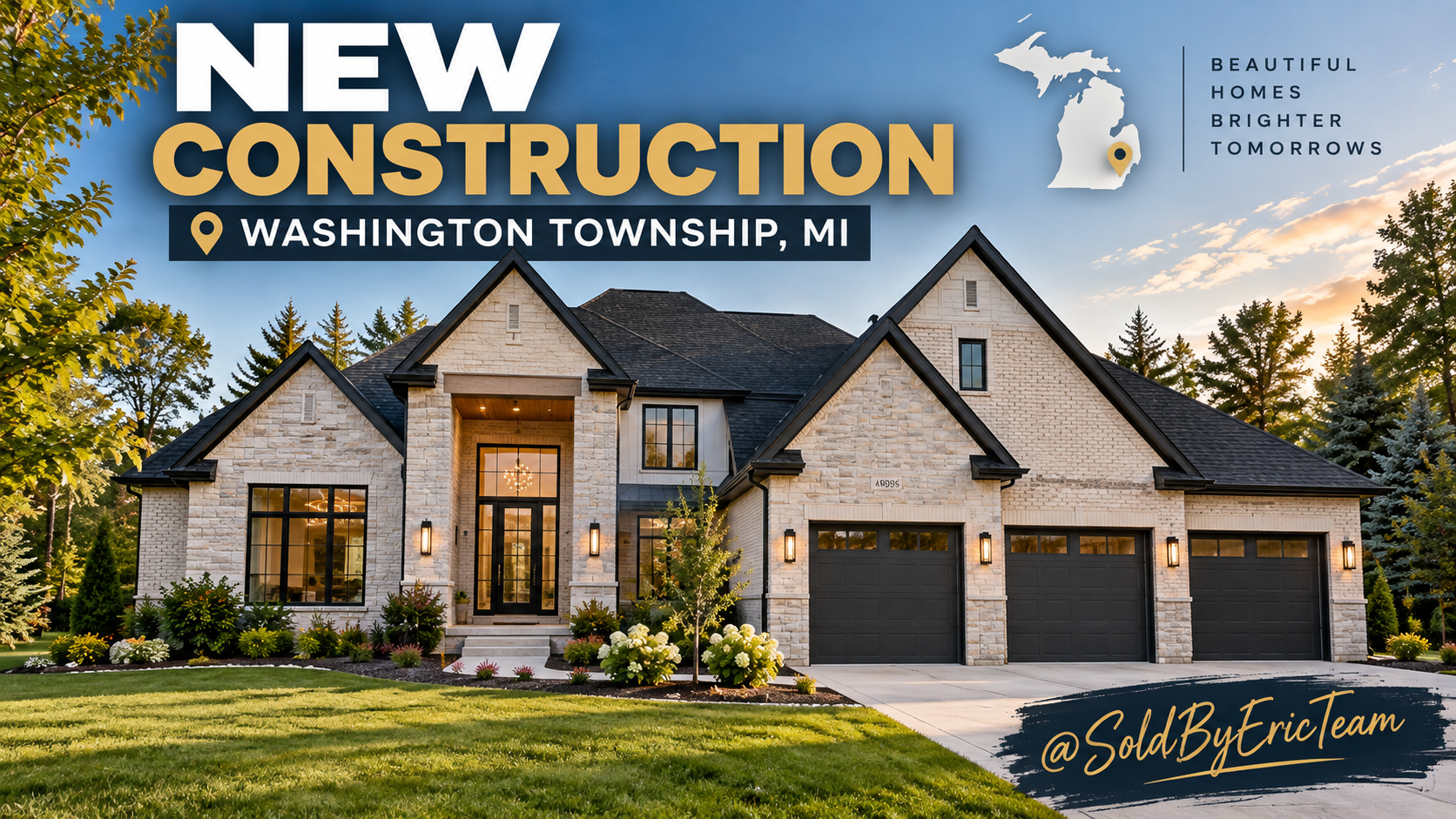
New Construction Homes in Washington Township MI: A Complete Buyer’s Guide
New construction homes in Washington Township MI offer buyers an opportunity to combine modern home design, newer building materials, energy-efficient features, and customizable living spaces with the suburban and semi-rural character of northern Macomb County. For buyers who want a home without decades of previous ownership, remodeling projects, or aging mechanical systems, new construction can be an attractive alternative to purchasing an existing property.
Buying a newly built home is different from purchasing a resale home, however. Buyers may need to compare builders, subdivisions, floor plans, included features, upgrade packages, construction timelines, warranties, lot premiums, and financing options before making a decision.
This guide explains what to consider when searching for new construction homes in Washington Township MI, how the building process typically works, and which questions can help buyers evaluate their options.
Why Are Buyers Looking for New Construction Homes in Washington Township MI?
Washington Township attracts homebuyers who want access to Macomb County while seeking more space and a residential environment outside the denser communities closer to Detroit.
New construction can be particularly appealing because buyers may find homes designed around the way households live today. Instead of adapting an older floor plan, buyers can potentially choose homes featuring larger kitchens, open gathering spaces, home offices, walk-in closets, mudrooms, modern primary suites, and attached garages.
The township can also appeal to buyers looking for a balance between residential development and areas that retain a more open character.
Individual neighborhoods vary considerably, so buyers should evaluate the specific location rather than assuming every Washington Township development offers the same experience.
What Types of New Construction Homes Are Available?
New construction homes generally fall into several categories. Understanding the differences can make the search considerably easier.
Quick Move-In Homes
A quick move-in home is already under construction or substantially completed when the buyer enters the process.
These properties can be useful for buyers who need to move sooner and do not want to wait for a home to be built from the ground up. The builder has usually already selected many structural features, materials, and finishes.
The advantage is a shorter and more predictable path toward occupancy. The tradeoff is that buyers typically receive fewer opportunities for customization.
To-Be-Built Homes
A to-be-built home allows the buyer to select an available homesite and floor plan before construction begins.
Depending on the builder and construction stage, buyers may be able to choose structural options, exterior selections, flooring, cabinets, countertops, fixtures, and other finishes.
This route provides greater personalization but usually requires more patience.
Spec Homes
A speculative or "spec" home is built by a builder without a specific buyer having ordered the property.
Builders select the floor plan and features based on what they believe will appeal to buyers. A spec home may be completed or still under construction when it becomes available.
For buyers who like the selections and want new construction without making hundreds of design decisions, this can be a practical middle ground.
Custom Homes
Custom construction gives buyers considerably more control over the design of their home.
Depending on the project, buyers may work with an architect, designer, and custom builder to determine the home's layout, materials, finishes, and special features.
Custom construction can offer tremendous flexibility, but buyers should expect a more involved planning process and potentially greater cost variability.
What Should You Compare Between New Home Communities?
The house itself is only one part of a new construction purchase. The surrounding community can have an equally significant effect on daily life and long-term ownership.
Buyers comparing new construction homes in Washington Township MI should consider the location of each development, lot dimensions, road layout, community rules, nearby development plans, homeowner association requirements, and access to everyday destinations.
A beautiful floor plan may not compensate for a homesite or location that does not fit the buyer's lifestyle.
Consider driving through the surrounding area at different times of day. Pay attention to traffic patterns, neighboring land uses, construction activity, road access, and the distance to places you expect to visit regularly.
How Much Do New Construction Homes Cost?
The advertised base price is only the starting point for understanding the potential cost of a new home.
A builder's base price generally represents a particular floor plan with a defined collection of standard features. Changing the homesite, structure, exterior, or interior selections can increase the final purchase price.
Potential additional expenses may include:
- Homesite or lot premiums
- Structural options
- Finished or upgraded basements
- Additional bedrooms or bathrooms
- Garage extensions
- Premium cabinets and countertops
- Flooring upgrades
- Electrical additions
- Lighting packages
- Appliance upgrades
- Landscaping
- Window treatments
- Decks or patios
- Homeowner association fees when applicable
Buyers should request a detailed explanation of what is included in the advertised price and what is considered an upgrade.
A model home can be particularly misleading if this distinction is overlooked. Models are designed to showcase possibilities and may contain numerous options that are not included in the standard home.
What Features Should Buyers Prioritize?
Not every upgrade provides equal value to every household.
A useful approach is to prioritize improvements that are difficult or expensive to change after construction.
Structural Choices
Structural decisions deserve particular attention because changing them later can require significant construction.
Examples might include an expanded garage, additional windows, ceiling changes, bedroom configurations, bathroom layouts, basement options, or changes to the footprint of the home.
Electrical and Technology Planning
Think about how the home will actually be used before electrical work is completed.
Buyers may want to consider additional outlets, dedicated circuits, exterior power, electric vehicle charging infrastructure, networking, security equipment locations, home-office connectivity, television locations, and future smart-home devices.
Kitchen Configuration
The kitchen is often one of the most heavily used areas of a new home.
Instead of focusing exclusively on finishes, consider functionality. Evaluate counter space, storage, pantry size, appliance placement, island dimensions, traffic flow, lighting, and proximity to dining and outdoor spaces.
Storage
Storage is easier to underestimate when viewing an empty floor plan.
Look at closet dimensions, pantry capacity, garage storage, mudroom organization, linen storage, basement space, and locations for seasonal belongings.
A home with a slightly smaller living area but excellent storage can sometimes function better than a larger home with poorly planned storage.
Should You Buy a Quick Move-In Home or Build From the Ground Up?
The better choice depends primarily on timing and how much customization matters to you.
A quick move-in home can make sense when your priority is obtaining a newly constructed property within a shorter period. Buyers can also see much more of the actual finished product before committing.
Building from the ground up can be preferable when specific structural features, design selections, or lot characteristics matter.
The tradeoff is time and uncertainty. Construction schedules can be affected by permitting, inspections, labor availability, materials, weather, utility work, and other circumstances.
Buyers with a strict move-out date from their existing residence should plan conservatively rather than assuming an estimated completion date is guaranteed.
How Does the New Construction Buying Process Work?
The exact process depends on the builder, but most purchases follow a recognizable sequence.
1. Establish Your Budget
Determine what you can comfortably spend before becoming attached to a particular model or collection of upgrades.
Consider the expected final price rather than only the advertised starting price.
2. Compare Builders and Communities
Visit multiple developments when possible.
Compare not just model homes but standard specifications, construction methods, warranties, community characteristics, lot availability, and purchasing procedures.
3. Choose a Floor Plan and Homesite
Evaluate how the floor plan fits your lifestyle and how it will sit on the selected lot.
Consider orientation, driveway placement, neighboring homes, backyard dimensions, drainage, utility equipment, easements, and surrounding land.
4. Review Pricing and Included Features
Request written information identifying standard features and additional-cost options.
This is the stage where buyers can begin distinguishing between the attractive advertised starting price and the likely cost of the home they actually want.
5. Review the Purchase Agreement
Builder contracts can differ substantially from contracts commonly used for resale properties.
Buyers should understand deadlines, deposits, financing requirements, construction changes, completion provisions, warranties, cancellation terms, and other obligations before signing.
6. Make Design Selections
For homes purchased early enough in construction, buyers may visit a design center or work through a structured selection process.
It helps to establish priorities before this appointment because individually appealing upgrades can add up quickly.
7. Monitor Construction
Construction progresses through stages that can include excavation, foundation work, framing, mechanical installation, insulation, drywall, interior finishes, exterior work, and final inspections.
The builder should explain when buyers are permitted to visit the construction site and how questions should be handled.
8. Complete Final Walkthroughs
Before closing, buyers typically have an opportunity to identify incomplete work or items requiring attention.
Document concerns carefully and understand the builder's process for addressing them.
9. Close and Move In
Once contractual, financing, inspection, and completion requirements have been satisfied, ownership transfers and the buyer can prepare for occupancy.
Should You Have a New Construction Home Inspected?
A newly built home can still benefit from independent professional evaluation.
New construction involves many contractors, trades, components, and installation stages. A home being new does not automatically mean every component was installed perfectly.
Depending on the circumstances and construction schedule, buyers may consider inspections at different stages of construction as well as before closing.
Buyers should confirm what inspections their contract permits and when an inspector may access the property.
An independent inspection should complement rather than replace municipal inspections and the builder's quality-control process.
What Should You Know About Builder Warranties?
Warranty coverage is an important part of evaluating new construction homes in Washington Township MI.
The existence of a warranty does not mean every issue will be covered for the same period.
Coverage may vary by component, workmanship category, structural issue, appliance, or manufacturer. Some products inside the home may carry separate manufacturer warranties rather than being handled exclusively through the builder.
Before purchasing, ask for the warranty documents and review:
- What is covered
- How long each category is covered
- What is excluded
- How warranty claims are submitted
- Expected response procedures
- Homeowner maintenance obligations
- Whether coverage transfers to a future owner
Keep copies of contracts, selections, warranties, manuals, inspection reports, and correspondence after closing.
How Important Is the Homesite?
The homesite can influence the experience of living in a new home almost as much as the floor plan.
Two identical houses in the same community can feel very different because of their locations.
Consider sunlight, neighboring properties, backyard orientation, road traffic, sidewalks, community entrances, common areas, retention or detention areas, utility equipment, easements, topography, and future construction.
Some lots carry premiums because of their size, location, views, or other characteristics.
Determine whether that premium provides meaningful value for your priorities rather than assuming the most expensive lot is automatically the best one.
What Should Buyers Know About Property Taxes?
Property taxes deserve careful attention when budgeting for new construction.
A newly constructed property's future tax situation may not be reflected accurately by estimates based solely on vacant land, incomplete construction, or another owner's circumstances.
Buyers should independently investigate how the completed property may be assessed and how Michigan property tax rules apply to their situation.
The important budgeting principle is simple: do not base a long-term housing budget solely on an early tax figure without understanding what it represents.
How Should You Evaluate the Location?
Location decisions should be based on your actual daily routine.
Consider commuting routes, major roads, grocery shopping, healthcare, recreation, restaurants, parks, schools when relevant, and the places you regularly visit.
Buyers interested in Washington Township often also evaluate nearby communities in northern Macomb County. Comparing surrounding areas can provide useful context regarding housing styles, lot sizes, community layouts, taxes, commuting patterns, and available amenities.
The goal is not simply to find the newest house. It is to find a home and location that work together.
What Are the Benefits of Buying New Construction?
New homes can offer several practical advantages.
Buyers may appreciate contemporary floor plans, modern materials, newer mechanical systems, current electrical infrastructure, energy-conscious construction, and opportunities to personalize certain features.
There can also be less immediate pressure to replace aging roofs, furnaces, air-conditioning equipment, windows, or other major components commonly encountered in older homes.
However, new construction is not maintenance-free.
Every homeowner still needs to maintain heating and cooling equipment, exterior materials, drainage, landscaping, plumbing fixtures, appliances, and other components.
What Are the Potential Drawbacks?
New construction also involves tradeoffs.
Buyers may pay additional amounts for upgrades that are already present in an existing home. Landscaping can initially be less mature, and active developments may experience construction traffic and noise while neighboring homes are completed.
Construction schedules can change, and a buyer building from the ground up may have to make numerous decisions within relatively short selection deadlines.
Some buyers enjoy that process. Others discover that they prefer the certainty of walking through an established home and seeing exactly what they are purchasing.
Understanding which type of buyer you are can help narrow the search.
New Construction vs. Existing Homes in Washington Township
Neither option is automatically better.
New construction may appeal to buyers who prioritize newer systems, contemporary layouts, personalization, and reduced near-term renovation needs.
An existing home may offer mature landscaping, established surroundings, completed outdoor improvements, and features installed by previous owners.
Resale homes can also provide more immediate certainty about the surrounding neighborhood because most nearby development has already occurred.
Compare total ownership costs rather than simply comparing asking prices.
A resale property that appears less expensive could require substantial renovations. Conversely, a new home with numerous upgrades, landscaping expenses, window treatments, and other post-closing purchases could cost considerably more than its original base price suggests.
Common Mistakes When Buying a Newly Built Home
One common mistake is treating the model home as though everything displayed is included in the base price.
Another is spending the entire budget on design upgrades while overlooking practical post-closing expenses.
Buyers should also avoid focusing entirely on the house while giving insufficient attention to the lot, neighborhood, future development, and daily commute.
Other mistakes include failing to read warranty documents, relying exclusively on estimated completion dates, skipping permitted independent inspections, and making major financial changes while a mortgage is being processed.
Careful preparation can make the buying experience significantly more predictable.
How to Compare Builders
A builder comparison should go beyond architecture and model-home appearance.
Ask each builder about standard construction specifications, energy-related features, warranty procedures, communication during construction, change-order policies, estimated timelines, inspection access, and what happens after closing.
It can also be useful to compare what each builder includes as standard.
A home with a lower starting price is not necessarily less expensive once comparable structural features and finishes are added.
Create an apples-to-apples comparison using the configuration you would realistically purchase.
What Should You Ask Before Signing a Contract?
Before committing to new construction homes in Washington Township MI, buyers should understand the financial and construction details of the transaction.
Questions worth addressing include:
- What exactly is included in the purchase price?
- Which features in the model home are upgrades?
- Is there a premium for the selected homesite?
- Which selections can still be changed?
- When do deposits become nonrefundable?
- How are construction delays addressed?
- What inspections are permitted?
- What warranty coverage is provided?
- Are there homeowner association requirements?
- Which landscaping or exterior features are included?
- How are unfinished items handled at closing?
- What additional expenses should be expected after moving in?
Written documentation is more useful than relying on assumptions or verbal impressions.
Questions Buyers Ask About New Construction Homes in Washington Township MI
How long does it take to build a new home in Washington Township MI?
Construction timelines vary according to the builder, floor plan, permitting, weather, labor, materials, utilities, inspections, and construction stage. Buyers should treat projected completion dates as estimates unless their contract specifically establishes otherwise.
Can I customize a new construction home?
Often, but the amount of customization depends on the builder and how far construction has progressed. A home purchased before construction begins may provide more choices than a quick move-in property nearing completion.
Are quick move-in homes actually new homes?
Yes. A quick move-in home is newly constructed but has already progressed through some or most of the building process. Because many selections have already been made, buyers generally have less opportunity to customize it.
Do I need an inspection on a brand-new house?
Many buyers choose to hire an independent inspector even for new construction. Buyers should review their contract and coordinate inspection timing and access with the builder.
Are the features in a model home included in the base price?
Not necessarily. Model homes frequently demonstrate available design and structural options. Ask the builder for written specifications showing which features are standard and which require additional payment.
Can new construction prices increase because of upgrades?
Yes. Structural options, premium homesites, interior selections, electrical additions, finished spaces, and other choices can increase the final price beyond the advertised starting price.
Should I choose the floor plan or lot first?
Both decisions should be considered together. The ideal floor plan may function differently depending on the lot's dimensions, orientation, neighboring properties, grading, easements, and other characteristics.
What should I prioritize at the design center?
Prioritize structural and difficult-to-change features first. Cosmetic items such as certain fixtures or finishes may be easier to replace later than structural modifications, electrical work, or major layout changes.
Can I negotiate when buying new construction?
Terms and flexibility vary by builder, development, home, and market conditions. Rather than considering only the purchase price, buyers should understand the entire package, including incentives, financing terms, upgrades, homesite premiums, and closing-related costs.
What should I budget for after moving into a new home?
Potential expenses can include window treatments, furniture, landscaping, fencing where permitted, storage systems, appliances not included by the builder, exterior living areas, and other personalization projects. The exact needs depend on what the builder provides.
How do I choose between a new construction and resale home?
Compare the total cost, location, lot, floor plan, maintenance expectations, renovation requirements, timeline, and level of customization. The right choice depends on which combination best fits your finances and lifestyle.
What is the first step when searching for a newly built home?
Start by establishing a realistic total budget and identifying your non-negotiable requirements. Then compare available communities, builders, floor plans, homesites, standard features, upgrades, and anticipated ownership costs.
Finding the Right New Home in Washington Township
A successful new-home search is about more than finding an attractive model. The builder, homesite, floor plan, specifications, contract, warranty, location, and final price all deserve careful consideration.
Take time to distinguish necessities from optional upgrades and compare properties using their expected finished cost rather than advertised starting prices. Review important documents carefully and obtain appropriate professional guidance for financing, contracts, inspections, taxes, or other specialized questions when needed.
With thoughtful preparation, buyers can evaluate new construction homes in Washington Township MI and confidently take the next step.

Eric Jurmo
| Sold by Eric Team | Eric Jurmo | Keller Williams Platinum
or another way